Demolition Services in Cedar Rapids, IA
Lorem ipsum dolor sit
Lorem ipsum dolor sit amet, consectetur adipiscing elit, sed do eiusmod tempor incididunt ut labore et dolore magna aliqua. Lorem ipsum dolor sit amet, consectetur adipiscing elit, sed do eiusmod tempor incididunt ut labore et dolore magna aliqua.
Inquire
Contact Us
We will get back to you as soon as possible.
Please try again later.
Our Services
Take It Down Cleanly And Haul It Away The Same Week
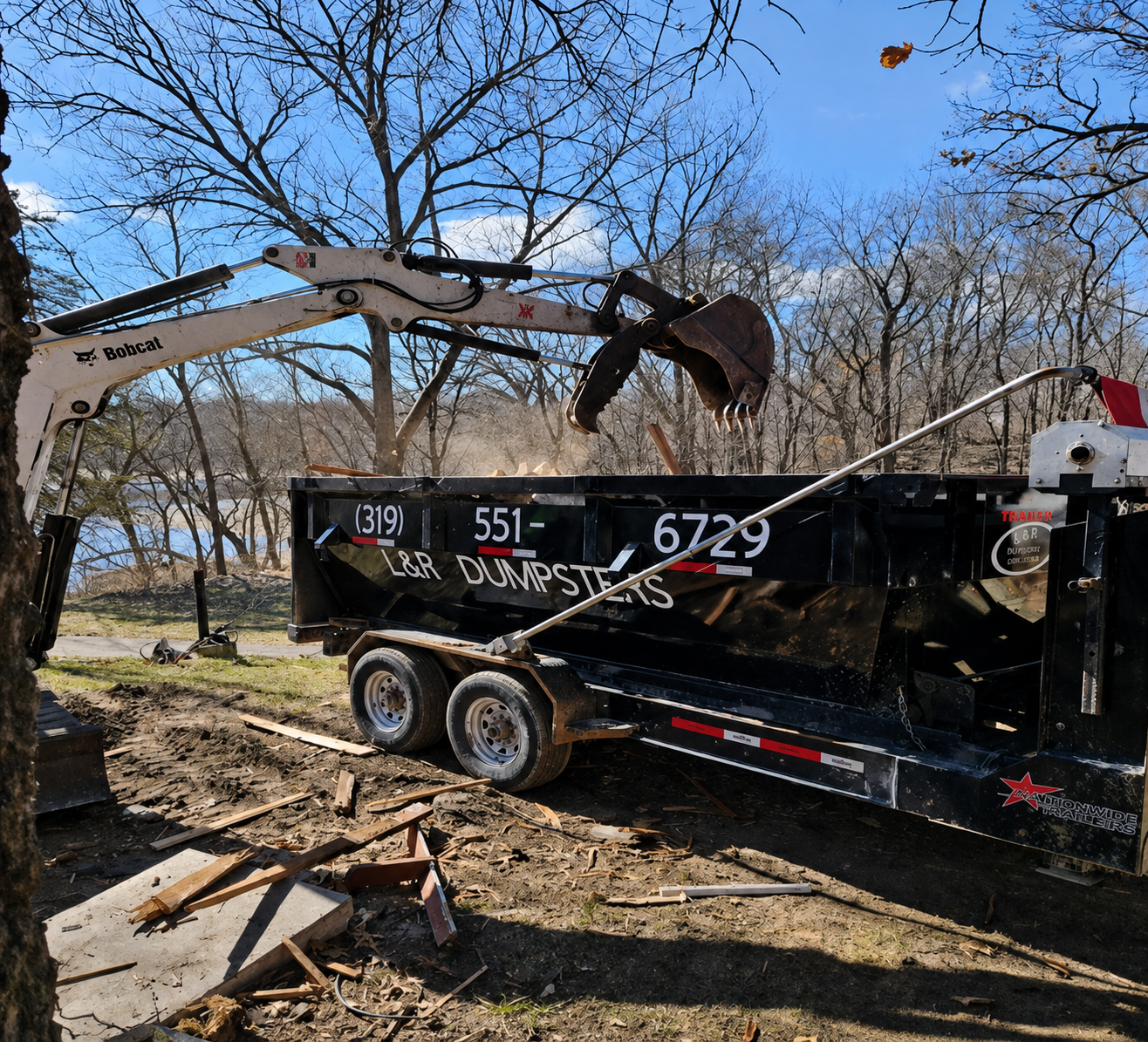
Iowa requires a written notification of demolition to be postmarked at least 10 working days before a structure comes down, and that clock starts long before any equipment arrives. Skipping it stops a project cold. L&R Dumpsters handles residential and light commercial demolition throughout Cedar Rapids, IA and the surrounding Linn County and Johnson County communities, from garden sheds and detached garages to full house and mobile home teardowns, with the debris hauled in our own containers.
Interior gutting before a remodel is handled the same way, with careful removal around what stays. Debris does not sit in a pile waiting for a subcontractor, because the containers are ours and they leave when they are full. We have worked these sites for 5+ years, and asbestos abatement is left to licensed abatement contractors rather than attempted in house. Start with a site visit through our contact page and a written scope of work.
Permits And Paperwork Come Before The First Swing
The demolition itself is the short part. Utility disconnects, notification windows, and permit approvals set the real start date, and a start before those clear only creates delay for everyone. Sequencing gets mapped at the site visit so the machine arrives on a day when it can actually get to work.
What happens after the structure falls matters just as much. Foundations get broken out or filled depending on what goes there next, the hole is backfilled, and the ground is left gradeable rather than cratered. Bring us the address and your plans for the lot through our contact page and we will scope it properly.
- Full structure teardowns
- Partial and interior demolition
- Detached garage removal
- Mobile home demolition
- Shed and outbuilding removal
- Foundation breakout and backfill
- Debris hauled in our containers
- Utility disconnect coordination
- Notification timelines tracked
- Site left graded and clear
- Residential and light commercial
- Written scope before work starts
Demolition Services We Provide
Whole House Demolition
Bringing a house down is mostly sequencing: disconnects confirmed, notifications filed, salvage pulled, then the structure taken apart from the top. Debris loads directly into containers instead of a yard pile, which keeps the lot workable for whatever comes next.
Mobile Home Demolition
Manufactured homes come apart differently than stick-built houses, with steel frames, tie-downs, and skirting that all need separate handling. The frame and axles have scrap value worth recovering rather than burying, and the pad is left clear. Nothing is left buried underneath.
Detached Garage and Shed Removal
Older outbuildings often lean long before anyone decides to act. Slabs get broken out or left in place depending on your plans, and the surrounding lawn, fence, and driveway stay intact through the work. Access routes get planned in advance.
Interior and Selective Demolition
Gutting to the studs takes more restraint than force. Load-bearing walls, wiring runs, and plumbing stacks stay protected while finishes, cabinetry, and old flooring come out, leaving a clean shell for the framing and mechanical trades behind you.
Concrete and Foundation Removal
Slabs, footings, and old foundation walls are heavy, awkward, and hard on equipment. Breaking them out properly matters because anything left behind interferes with grading, drainage, and whatever gets built on that footprint later. Removal depth depends on your plans.
Site Clearing and Debris Hauling
Once a structure is down, the lot still has to become useful. Debris leaves, the hole gets backfilled with suitable material, and the surface is left roughly graded so seeding, paving, or a new build can begin. No second cleanup contract needed.
Why Choose Us for Demolition
Paperwork Handled Before the Machine Rolls
A stalled project usually traces back to something nobody filed. Notification windows and disconnect confirmations get tracked from the first site visit, so the start date you are given is one that actually holds. Delays cost more than diligence does.
One Team Instead of Three Vendors
Coordinating a demo contractor, a hauler, and a container company means three schedules and three invoices. Doing the teardown and the hauling together removes the gaps where debris sits and days quietly disappear. One schedule and one point of contact.
Honest Limits on Hazardous Material
Asbestos work belongs to licensed abatement contractors, and hearing that plainly beats discovering it midway through. Knowing where the line sits protects your timeline far more than a contractor willing to promise anything. You hear it at the site visit.
A Lot Left Ready for What Follows
A cratered, debris-strewn site is a second project. Backfilling and rough grading mean the next contractor, or the next season, starts from usable ground rather than from cleanup nobody budgeted for. Rough grading is included rather than quoted separately later.
Care for Everything Staying Put
Neighboring fences, mature trees, driveways, and the house you are keeping all deserve to survive the week. Access routes and equipment placement get planned around them rather than treated as acceptable collateral. Protecting what remains costs far less than repairing it.
Written Scope, No Moving Targets
Verbal understandings on a demolition job go wrong fast. Putting the scope, the disposal, and the finish condition in writing means both sides know what done looks like before anyone starts an engine. Both sides agree on it before anything starts.
why choose us?
Quick Response Time
We understand that cleanup projects and waste removal needs can come up quickly, so we prioritize prompt responses and make it easy to get the dumpster or service you need without unnecessary delays.
Fast Deliveries
We provide efficient dumpster delivery throughout Cedar Rapids and the surrounding communities, helping you keep your construction, cleanup, or removal project moving on schedule.
Same-Day & Next-Day Drop-Offs
We offer same-day and next-day dumpster drop-offs when availability allows, giving our customers a convenient solution when they need a dumpster on short notice.
Customer-Focused Service
We put our customers first with friendly communication, straightforward service, and dependable support throughout the rental and pickup process.
Lorem ipsum
A Clear Lot and a Start Date That Holds
Demolition looks like the dramatic part of a project, but the value is quieter than that: the right paperwork filed on time, the structure down in a day rather than a fortnight, the debris gone before it becomes someone else's problem, and a lot that is genuinely ready for what comes next. L&R Dumpsters has been taking down houses, garages, mobile homes, and interiors across Cedar Rapids, IA for 5+ years, hauling every load in our own containers. Send the address and what you have in mind through our contact page for a site visit and a written scope. The sooner that starts, the sooner your notification clock does too.
Frequently Asked Questions
What notification is required before demolishing a structure in Iowa?
A written notification of demolition and renovation must be postmarked at least 10 working days before work begins. It applies regardless of the age of the structure, and starting early avoids a needless delay. Filing early costs you nothing.
How long does it take to tear down a garage or shed?
A detached garage typically comes down in a day, with hauling finished the same day or the next. Slab removal adds time, and access and weather affect the pace. Most L&R Dumpsters teardowns around Cedar Rapids, IA finish inside a single week.
What is the difference between full and interior demolition?
Full demolition removes the entire structure down to the foundation. Interior or selective demolition strips finishes, fixtures, and non-structural walls while the shell, roof, and load-bearing framing stay intact for the remodel that follows. Permitting requirements differ between the two.
Do utilities need to be disconnected first?
Yes, and this is the single most common cause of delay. Gas, electric, water, and sewer all require confirmed disconnection by the utility, and the paperwork proving it usually has to precede any permit approval. Start those calls as early as possible.
What happens to the foundation after a house comes down?
It depends on what the lot becomes. Foundations are either broken out entirely and hauled off or crushed and used as fill, then covered and graded. Your plans for the site decide which approach fits. Decide that before demolition begins.
Can a mobile home be demolished where it sits?
It can, and often that is simpler than transporting it. The unit is dismantled in place, the steel frame and axles go to scrap, and the pad, blocks, and tie-downs are cleared afterward. Transport permits and route restrictions disappear entirely.
How is asbestos handled during demolition?
Suspect materials are identified before work starts and abatement is performed by licensed abatement contractors, never by a demolition contractor. L&R Dumpsters coordinates around that schedule on projects across Cedar Rapids, IA rather than working through it. Testing comes before any teardown.
What does site cleanup include once the structure is down?
Debris is loaded and hauled, the foundation void is backfilled with suitable material, and the surface is rough graded. What you are left with is ground ready for seeding, paving, or a new footprint. Nothing is left for you to arrange.